

by Sim Kern
Interlink Books, 2025
Sim Kern’s Genocide Bad.[1] presents itself as a call to conscience for young readers. Its thesis, that Israel is committing genocide in Gaza, is declared based on the author’s ideological beliefs, rather than proven with evidence. In place of a logically reasoned argument supported by facts and expert opinion, Kern presents a memoir of becoming an anti-Israel activist alongside a primer on viewing the Middle East and the world through the author’s extreme anti-Western lens. Though the book purports to be educational, the author seeks to influence young readers using any available means, even unethical propaganda techniques. With its Internet-influencer tone and anti-Western lens, Genocide Bad. offers an extreme and simplistic ideological point of view on the Israeli Palestinian conflict, reducing one of the world’s most complex historical and geopolitical issues to emotional slogans and moral absolutism.
Educators and librarians evaluating this book as a potential teaching tool should be concerned that the author approaches the subject of the Middle East conflict as a biased Internet influencer, not as an impartial or open-minded educator. Kern wrote the book at the invitation of Hannah Moushabeck,[2] an anti-Israel activist and publisher, based on two qualifications: Jewish identity and an Internet following for anti-Israel, anti-Zionist propaganda. The author has no expertise in Palestinian or Jewish history and has never visited the Middle East (ix). Consequently, the book suffers from the author’s biases against religion, Judaism, Israel, the United States, and Western democratic values.
The author’s contempt for Judaism pervades the book and informs its argumentation. Kern ridicules “whatever mystical connection Zionists want me to feel for the ‘Holy Land’” (ix), when, in fact, a connection to Israel as the Jewish homeland (Zionism) is an accepted tenet of Jewish religious faith.[3] Kern dismisses 2,500 years of Talmudic study as not worth the time before pronouncing the God of Exodus “patently unreliable, impossible to satisfy, and one who would murder children” (178), the Torah “a blueprint for violent settler colonization” (180), and Abraham, “a piece of shit by any measure of a man” (180). Readers may question an author who announces a complete absence of knowledge or curiosity about thousands of years of scholarship of a major world religion and then proceeds to trash that religion’s central tenets with no supporting evidence.
The book also suffers in reliability from its author’s bias as a radical anti-Western “anarchist” (199). Kern views Israel as an “imperial power” (92), the United States as a greedy overlord plundering the “global South” (93), the American Democratic Party as a pursuer of “fascist policies” (19), and the Geneva Conventions as “a convenient pretext for the U.S. to invade … any nation” (93).These extreme anti-Western beliefs lead Kern to propose anarchy– the absence of any nation-state in present-day Israel or the Palestinian Territories — as the solution to the heartbreaking war in Gaza (201). While anarchy may offer an interesting theme for the author to explore as a writer of utopian fiction (200), anarchy in the real world would leave both Palestinians and Israelis even more open to exploitation by Hamas terrorists and their allies, whose actions led directly to Gaza’s devastation.
In addition to having extreme and unrealistic ideas, Kern lacks faith in readers to develop principled stands based on factual research and the study of diverse expert opinions. The author’s stated purpose is to “convert” readers to Kern’s ideological perspective (xi). Disturbingly, this ideological goal supersedes educational values, including fairness and impartiality. Kern even urges readers to denigrate others:
Call for a free Palestine because it’s cool. Wear a keffiyeh because you look great in one. Dunk on Zionists because you don’t want to be associated with them, because they’re the biggest dorks and losers on the planet. Say “Free Palestine” … for clout, for followers, for fame, or for deep moral conviction — it’s all the same to me (208).
As this quote demonstrates, Kern is comfortable gaining followers via unethical means, such as name-calling and pandering to young readers’ desire for “coolness” or popularity. These manipulative techniques are red flags showing that respect is reserved only for those who agree with the author’s point of view.
Alongside emotional pandering and an extreme ideological lens, the book’s other major shortcoming is a failure to articulate an evidence-based case regarding genocide. Such a case would start with a definition of the term, which Kern does not provide.[4] Instead, Kern tries to associate Israel with genocide by mislabeling Israel as a “settler colonial apartheid ethnostate.”[5] However, even if this label were accurate, which it is not, settler colonialism and apartheid are different wrongs than genocide, and none apply to Israel. Finally, Kern abandons the strategy of genocide by ideological association, finding it “much harder … to explain” (10), in favor of a memoir about the author’s political development. However, a diary of one’s intellectual journey does not replace a factual argument to make one’s case. In short, Kern never makes an affirmative, fact-based, logically compelling argument for this book’s thesis.
The absence of a coherent argument of the book’s central issue reflects the reality that Israel is not committing genocide in Gaza. Despite the tragic loss of civilian life in Gaza, civilian casualties in war, even on a massive scale, do not constitute genocide. In the companion text, Genocide Bad Workbook, author Steven Morgan quotes the United Nations definition of genocide as “acts committed with the intent to destroy, in whole or in part, a national, ethnic, racial, or religious group” (5). The intent of the perpetrator of genocide must be to eradicate a particular national, ethnic, racial or religious group, and Israel has never acted with such intent.
Israel’s statements and actions since October 7, 2023 make clear its purpose is to destroy the terrorist group Hamas, not to eradicate “a national, ethnic, racial, or religious group, in whole or in part,” as the definition of genocide requires. This distinction is critical because Israel has a legitimate basis for its counterattack on Hamas following Hamas’ military assault, 1200 murders, 250 kidnappings, countless rapes, and other crimes against humanity committed on October 7.[6] On October 8, Netanyahu identified Israel’s military target as Hamas, not the people of Gaza: “All of the places which Hamas is deployed, hiding and operating in, that wicked city, we will turn them into rubble. I say to the residents of Gaza: Leave now because we will operate forcefully everywhere.”[7] Prime Minister Netanyahu would not have encouraged Gazans to leave the field of battle, were Israel’s aim to commit genocide.
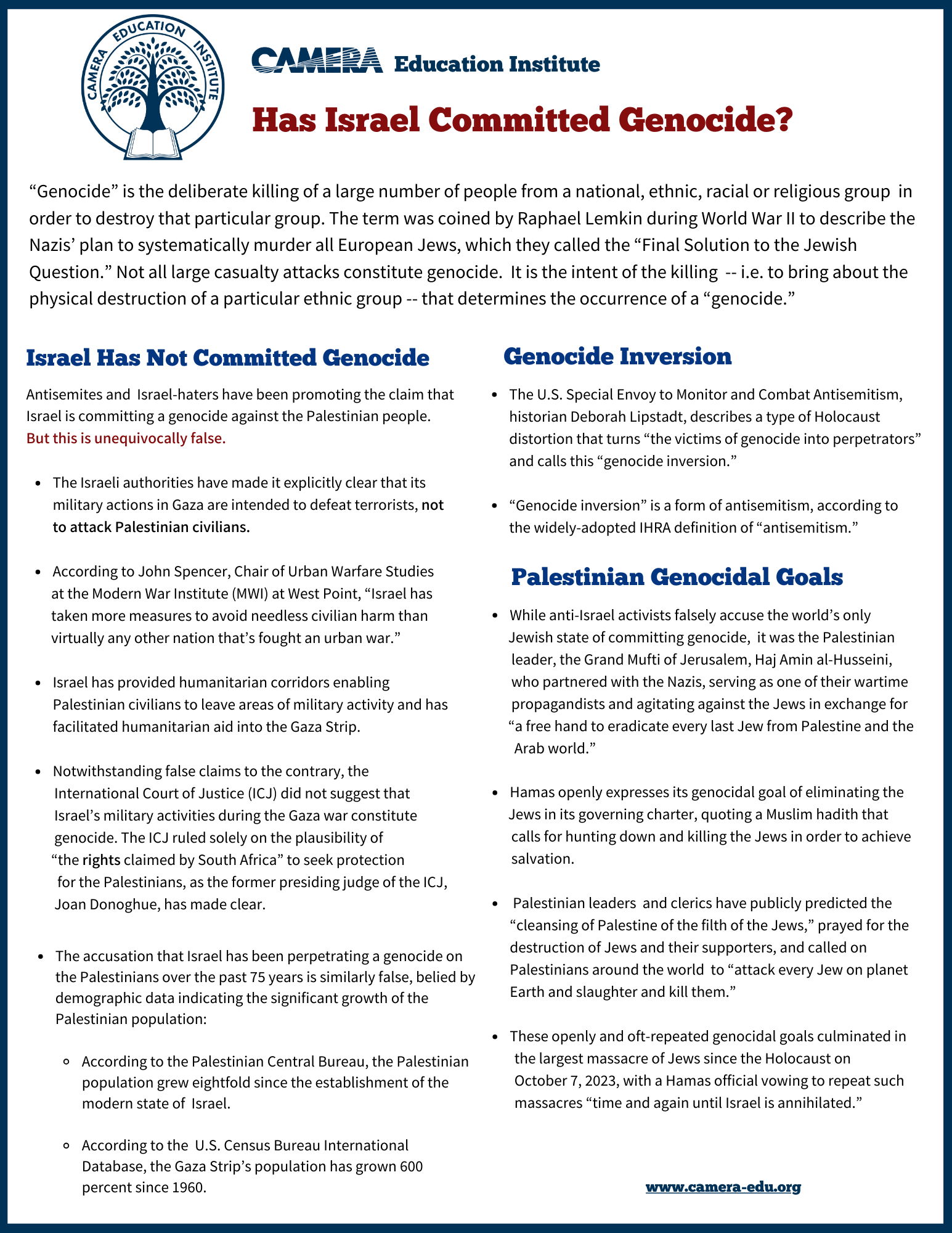
Moreover, Israel’s methods of conducting war before and since October 7th demonstrate that the country’s aims are not genocidal. According to John Spencer, Chair of Urban Warfare Studies at the Modern War Institute (MWI) West Point, “Israel has taken more measures to avoid needless civilian harm than virtually any other nation that’s fought an urban war.”[8] These measures include warning Palestinians of incoming attacks; leaving corridors open to allow civilians to flee; and providing humanitarian assistance. It is not now, nor has it ever been Israel’s intent to rid the world of Palestinians, as was the intent and near success of the Nazis’ genocide toward the Jews during the Holocaust.[9]
Because Kern cannot build an affirmative argument for the thesis of genocide, the bulk of the book consists of rebuttals to Israel’s fact-based positions. The nine chapters of rebuttal, steeped in settler colonial ideology and unreliable and inapt evidence, are subtitled “Answering Hasbara.” (Hasbara, a Hebrew word traditionally used to mean to educate based on argument and reason, has been seized on by anti-Zionist conspiracy theorists as code for Israeli propaganda.[10]) The rebuttals blend all the book’s faults: extreme bias, overreaching ideology, and distortions of facts.
Nowhere are the rebuttals’ extreme bias and disregard of pertinent facts better shown than in the author’s attempted rehabilitation of Hamas and glorification of its leader, Yahya Sinwar. Sinwar was the architect of October 7th, an attack whose trauma to Israel made it not only the worst massacre of Jewish citizens since the Holocaust, but also the deadliest single-day attack in the world to date based on the number of deaths per capita.[11] Instead of providing balanced coverage, Kern devotes over ten pages to justifying the bombings and massacres of civilians committed by Hamas and its allies, including on October 7th, and a full four pages refashioning Sinwar’s death into a heroic martyrdom. The author concludes by mislabeling Israel’s killing of Sinwar, rather than Sinwar’s killing of 1,200 Israelis, a “war crime” (79).
Against more than ten pages of content rehabilitating Sinwar, Kern spends one sentence condemning Hamas for its actions on October 7th. Omitted from Kern’s account are the following facts reported by Human Rights Watch:[12] On October 7, 2023, Hamas’ military wing, the Qassam Brigades, and at least four other armed Palestinian groups murdered more than 1,200 unarmed citizens; captured, tortured, and subjected to ill treatment some 250 hostages; committed rape, gang rape, and sexual violence; pillaged, looted, and destroyed property, and committed numerous war crimes and crimes against humanity.[13] Moreover, Kern omits the significant finding by Human Rights Watch research and others, “that the assault was designed to kill civilians and take as many people as possible hostage.”[14] In other words, these tragedies were not collateral damage, as with Israel’s counterattack in Gaza; Hamas’ atrocities were war crimes committed with intention.
In conclusion, readers of any age seeking an informed, unbiased understanding of the conflict between Israel and Gaza in the aftermath of October 7th should look elsewhere than Genocide Bad. Its author has recycled ideological content and Internet slang to create a counter factual and illogical polemic accusing Israel of genocide. The Middle East conflict is far more complex, both historically and politically, than Kern is willing to admit. However, the author’s goal is not actually to educate readers; it is to inflame readers against Israel regardless of their understanding of the issues. For readers seeking information or a nuanced understanding of the historical and political realities behind the current conflict in the Middle East, there are far better books than this one.[15]
-Reviewed by Anne Rubinovitz/August 7, 2025
[1] Sim Kern, Genocide Bad. (Northampton, Mass: Interlink Books, 2025). Future references to this book will be made using in-text parenthetical citations.
[2] Moushabeck is the co-owner of Interlink Publishing, which describes itself as “the only Palestinian-owned publisher in the U.S.” For a short review of Moushabeck’s 2023 children’s book, which omits Jews from maps, illustrations, and text regarding Jerusalem, see https://www.camera-edu.org/review/homeland-my-father-dreams-of-palestine/.
[3] The central prayer of Judaism begins “Hear, O Israel;” Jews face toward Jerusalem during prayer; and Jewish Seders end with the phrase “Next Year in Jerusalem” are a few of the many Jewish liturgical and devotional references to Israel.
[4] A definition and etymology of genocide are offered only in a companion workbook by a different author.
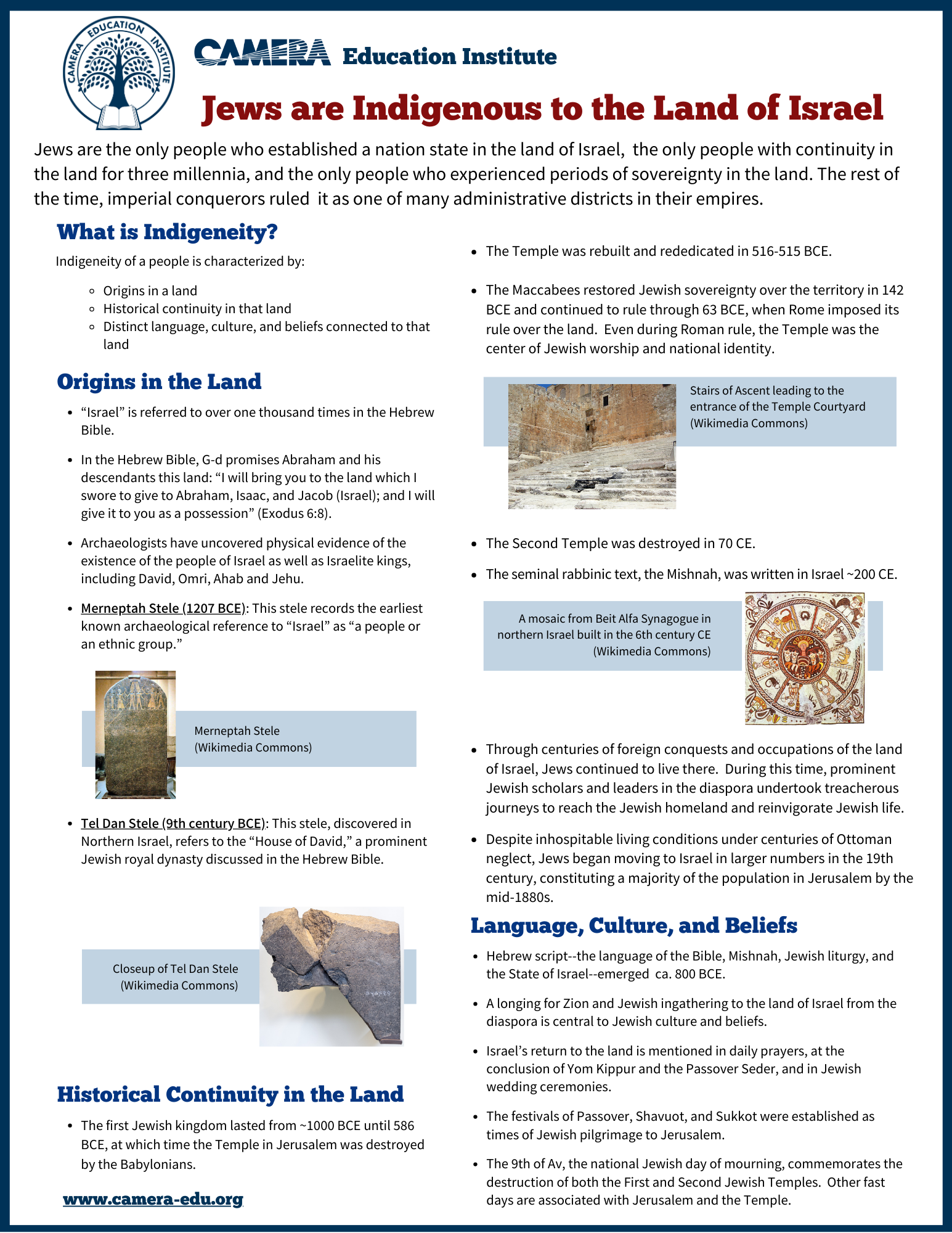
[5] For talking points on Israel’s status as an indigenous people to the nation of Israel, see Camera Education Institute, “Jews Are Indigenous to the Land of Israel,” https://www.camera-edu.org/wp-content/uploads/2025/02/Indigenous.png.
[6] “Swords of Iron: War in the South – Hamas’ Attack on Israel,” Israeli Ministry of Foreign Affairs, https://www.gov.il/en/pages/swords-of-iron-war-in-the-south-7-oct-2023.
[7] “Statement by Prime Minister Benjamin Netanyahu,” Israeli Ministry of Foreign Affairs, https://www.gov.il/en/pages/statement-by-pm-netanyahu-7-oct-2023.
[8] See https://www.newsweek.com/israel-implemented-more-measures-prevent-civilian-casualties-any-other-nation-history-opinion-1865613.
[9] For more facts showing Israel’s lack of genocidal intent, see Camera Education Institute, “Has Israel Committed Genocide,” https://www.camera-edu.org/wp-content/uploads/2025/02/IsraelGenocide.png.
[10] “The Real Meaning of Hasbarah (and Hasbara),” https://mosaicmagazine.com/observation/israel-zionism/2019/05/the-real-meaning-of-hasbarah-and-hasbarah/.
[11] See Hamas’ October 7 Attack: Visualizing the Data, Center for Strategic and International Studies, https://www.csis.org/analysis/hamass-october-7-attack-visualizing-data for important charts clarifying the psychological toll of October 7 on Israel.
[12] Human Rights Watch, “October 7 Crimes Against Humanity, War Crimes by Hamas Led Groups, https://www.hrw.org/news/2024/07/17/october-7-crimes-against-humanity-war-crimes-hamas-led-groups.
[13] “I Can’t Erase All the Blood from My Mind, Palestinian Armed Groups’ October 7th Assault on Israel,” Human Rights Watch (July 17, 2024), https://www.hrw.org/report/2024/07/17/i-cant-erase-all-blood-my-mind/palestinian-armed-groups-october-7-assault-israel.
[14] Ibid.
[15] For suggested fact-based readings on Israel, please see https://www.camera-edu.org/recommended/, the CAMERA Education Institute’s curated booklist for K-12 students.